 Toward Sustainable Computing with FPGAs and Chiplets
Abstract
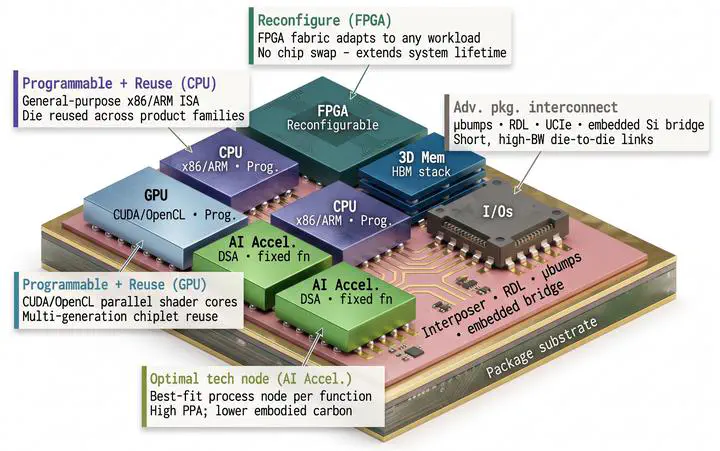
The unprecedented growth of artificial intelligence (AI) and large-scale computing systems has significantly increased the environmental impact of modern computing infrastructure. Sustainable computing requires a holistic view of system design where both embodied carbon footprint (CFP), arising from design, manufacturing, packaging, and end-of-life processing, and operational CFP, arising during system deployment and use, are jointly considered. As Moore’s law slows, computing systems are increasingly shifting toward heterogeneous integration (HI) architectures that combine specialized chiplets within advanced packages to improve performance, energy efficiency, scalability, and modularity. HI systems with FPGA chiplets represent an important pathway toward sustainable computing by combining modular chiplet-based integration with FPGA reconfigurability and adaptability. Such systems can potentially reduce lifecycle CFP while continuing to provide strong performance, flexibility, and support for rapidly evolving AI workloads. This paper discusses modeling and optimization approaches for HI systems with FPGA chiplets with CFP treated as a primary optimization metric alongside traditional design objectives. The paper further highlights research challenges spanning architecture, packaging, compilers, runtime systems, manufacturing, and EDA, and outlines future opportunities for sustainability-aware design.

Chetan Sudarshan
Ph.D. Candidate at Arizona State University
My research interests include sustainable computing, heterogeneous integration, chiplets, and computer architecture